
Where are experiments on monkeys conducted in Germany?
The system of animal experimentation is characterized by secrecy and a lack of transparency—even when it comes to our closest relatives, non-human primates. There is no exact official information available on where in Germany monkeys are used in experiments or on what happens to them.
Attempts to obtain more detailed information about the use of monkeys in the individual federal states prove difficult as well. The German Federal Institute for Risk Assessment (BfR) publishes an annual statistic on animal experiments in the federal states. This consists of only a single table per state, thus offering far less insight than the nationwide statistics, which lists the types of experiments and the severity levels of those experiments in 47 separate tables. The state-level tables only mention the broad experimental purposes and the animal species involved.
Research
We have compiled all the available evidence and information in order to create some transparency for the public on where monkeys suffer and die in animal experiments in Germany.
The research is based on:
- the BfR statistics for the federal states (1)
- entries in our database on animal experiments, based on scientific publications (2)
- publicly available responses to official inquiries.
Number of monkeys used in animal experiments in Germany and the federal states
Over the past ten years, there were numerous annual reports of well over 3,000 monkeys being used nationwide. In the most recently published statistics for 2023, the number dropped to 1,733, the lowest level in the past ten years.
|
Year |
2013 |
2014 |
2015 |
2016 |
2017 |
2018 |
2019 |
2020 |
2021 |
2022 |
2023 |
|
Number of |
2.165 |
2.839 |
3.141 |
2.462 |
3.525 |
3.288 |
3.276 |
2.031 |
1.915 |
2.267 |
1.733 |
Table 1: Number of monkeys per year in Germany (first-time and repeated use combined).
In 2023, official statistics mention the use of non-human primates in 7 federal states. However, the real number is 8, since Bremen hasn’t counted animals used in brain research for years.
Non-human primates are often kept and used in laboratories for many years or even several decades. Animals are only listed in the statistics once an experimental project has been completed. The official surveys must therefore be interpreted with caution and the likelihood that significantly more monkeys are actually involved in experiments has to be kept in mind. The overview of the federal states clearly shows that North Rhine-Westphalia is by far the largest user of monkeys.
|
Federal state |
Number of non-human primates 2023 |
|
Baden-Württemberg |
107 |
|
Bavaria |
1 |
|
Bremen |
0 |
|
Hesse |
7 |
|
Lower Saxony |
129 |
|
North Rhein-Westphalia |
1.479 |
|
Saxony |
6 |
|
Saxony-Anhalt |
4 |
|
Total |
1.733 |
Table 2: The numbers are the sum first-time and repeated use.
Monkey experiments at 14 institutions in 8 federal states
The following table lists the institutions which have conducted experiments on monkeys since 2018 in the 8 federal states in question along with the monkey species and the field of research:
|
Federal state |
Institution |
Species |
Type of research |
|
Baden-Württemberg |
Hertie Institute for Clinical Brain Research, Tübingen |
Rhesus macaques |
Brain research |
|
Department of Zoology, University of Tübingen |
Rhesus macaques |
Brain research |
|
|
Excellence Cluster Werner Reichhardt Center for Integrative Neuro Science, Tübingen |
Rhesus macaques |
Brain research |
|
|
Boehringer Ingelheim, Biberach an der Riß Maybe other pharmaceutical industry |
Long-tailed macaques |
Regulatory experiments / applied research |
|
|
Bavaria |
Walter Brendel Center for Experimental Medicine, Ludwig Maximilians University of Munich |
Baboons |
Xenotransplantation research |
|
Bremen |
Department of Brain Research, University of Bremen |
Rhesus macaques |
Brain research |
|
Hesse |
Neurophysics, University of Marburg |
Rhesus macaques |
Brain research |
|
Ernst Strüngmann Institute, Frankfurt am Main |
Rhesus macaques Common marmosets |
Brain research |
|
|
Paul Ehrlich Institute, Langen |
Vervet monkey Squirrel monkeys maybe others |
Research on infections diseases and others |
|
|
Lower Saxony |
German Primate Center, Göttingen |
Prosemians Marmosets Rhesus macaques Long-tailed macaques Baboons |
Brain research Research on infections diseases and others |
|
Until 2020: Laboratory for Pharmacology and Toxicology (LPT), Mienenbüttel |
Long-tailed macaques |
Regulatory experiments |
|
|
North Rhein-Westphalia |
Labcorp Drug Development (formaly Covance), Münster |
Long-tailed macaques |
Regulatory experiments |
|
Centrum for Reproduktion Medicine and Andrology (CeRA), University of Münster |
Common marmosets |
Basic research (reproduction medicine) |
|
|
Until 2025: Bayer AG, Wuppertal |
Long-tailed macaques |
Regulatory experiments |
|
|
Saxony |
University of Leipzig |
Common marmosets |
Basic research |
|
Saxony-Anhalt |
Leibniz Institute for Neurobiology, Magdeburg |
Long-tailed macaques |
Brain research |
Table 3: Compilation of the institutions which have conducted experiments on monkeys since 2018 along with the monkey species and the field of research.
Federal states
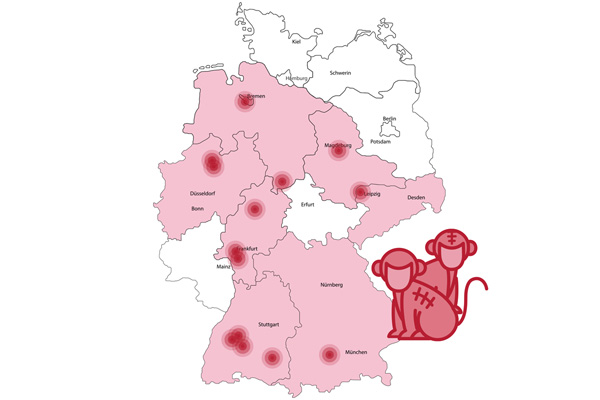
Grafik 1: 14 institutions in 8 federal states conduct experiments on on-human primates in Germany.
Federal states where no experiments on monkeys are conducted
- Monkeys have not been used in the following federal states since at least 2010: Hamburg, Rhineland-Palatinate, Saarland, Mecklenburg-Western Pomerania, Schleswig-Holstein
- Since 2011, no use of monkeys: Thuringia
- Since 2015, no use of monkeys: Brandenburg
- Since 2020, no use of monkeys: Berlin
Baden-Württemberg
Until 2015, four facilities in Baden-Württemberg conducted brain research on monkeys. Following an undercover investigation that revealed disturbing footage and the resulting public outcry, the Max Planck Institute for Biological Cybernetics ended its monkey experiments in 2017 (3).
A veterinary pathology report from 2009 on monkeys who died at the institute documented the severe suffering experienced by the animals in these experiments. The skull of one monkey showed more than 20 drill holes. Furthermore, his chewing muscle had been severed, and numerous puncture injuries were detected in the brain (4). These findings illustrate the invasive procedures carried out in monkey brain research.
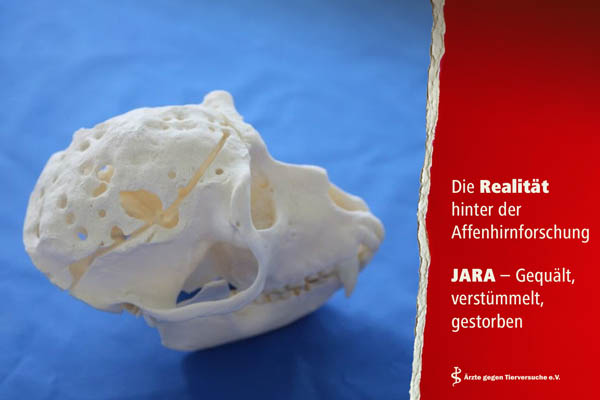
Skull of the monkey Jara from the Max Planck Institute for Biological Cybernetics Tübingen.
However, monkeys continue to suffer in brain research at three other facilities in Tübingen:
-
Hertie Institute for Clinical Brain Research, Tübingen
-
Department of Zoology, University of Tübingen
-
Werner Reichardt Center for Integrative Neuroscience, Tübingen
In our database on animal experiments (www.datenbank-tierversuche.de), we list two experiments on long-tailed macaques, from 2021 and 2024 respectively, that were carried out at Boehringer Ingelheim in Biberach an der Riß. In one experiment, 13 long-tailed macaques were injected with a test substance into the vitreous body of both eyes. Blood samples were taken repeatedly. Up to ten weeks after the injection, several monkeys were killed (5). It is unclear whether Boehringer Ingelheim alone accounts for the total number of long-tailed macaques used in these fields or whether other facilities are involved.
Bavaria
For many years, monkey brain research was conducted at Ludwig Maximilian University of Munich (LMU) until, in 2006, the authority in charge refused to grant approval for further experiments (6).
Since then, there has been only one animal experimentation facility in Bavaria that uses monkeys. At the Walter Brendel Center for Experimental Medicine at the LMU, baboons have been used in xenotransplantation research since at least the early 2000s. In these experiments, hearts and other organs from pigs are transplanted into the non-human primates. The animals often die after a few hours or after several weeks or months, frequently under severe suffering (7). Each year, between two and ten baboons die in such experiments.
Bremen
At the Department of Brain Research at the University of Bremen, brain research on non-human primates has been conducted since 1997. Years of public protests and several political attempts to stop the experiments have so far failed to prevent the ongoing suffering of rhesus macaques in these invasive studies (8).
What is particularly unusual is that these animals don’t appear in the annual animal experimentation statistics. In these statistics, monkeys were last reported in 2011; since then, not a single monkey has been listed. According to the German Federal Institute for Risk Assessment (BfR), this is legally permissible because it is considered a “continuous use of an experimental animal.” This wording refers to an ongoing experiment that can extend across several approval periods during which the same animal is used continuously. The animals only have to be reported for statistical purposes once they are killed or the experiment has otherwise been concluded (9). Animals who die or are killed for other reasons, for example due to age or illness, don’t have to be included in the statistics.
Rhesus macaques have been kept at the University of Bremen for 28 years and used “continuously” in experiments apparently. In the past 14 years, monkeys have appeared in the statistics only once – in 2010, when four “Old World monkeys” were listed. It is highly unlikely that not a single experiment was completed or that no monkey was killed during this long period. Despite repeated notifications from our side, the responsible authorities have not taken action.
Hesse
The University of Marburg and at the Ernst Strüngmann Institute (ESI) in Frankfurt accommodate facilities where monkeys are used in brain research for extended periods of time.
According to federal state statistics, 1–5 rhesus macaques and a few (0–2) marmosets and long-tailed macaques are used in Hesse per year and can be attributed to these two institutes. Whistleblower information revealed that in 2024 the ESI kept 17 rhesus macaques, one long-tailed macaque, and 19 marmosets (10).
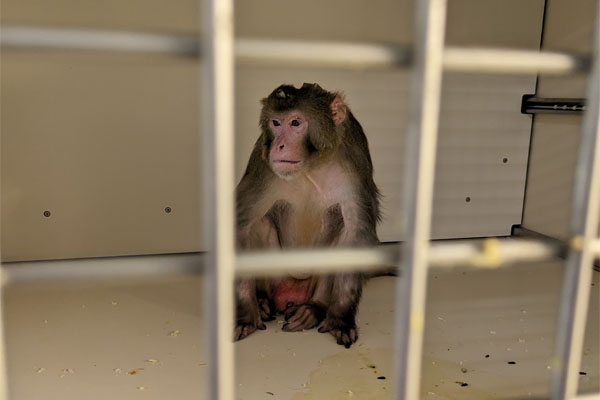
Over 20 years with equipment bolted to his skull: Rhesus macaque Homer at the Ernst Strüngmann Institute Frankfurt (ESI). Credit: SOKO Tierschutz
Hesse is the only federal state in which squirrel monkeys, vervet monkeys and “monkeys of other species” are used. Between 2016 and 2021, 4–14 vervet monkeys were reported annually. Since then, none have been recorded. In 2018, 25 squirrel monkeys were reported in the statistics. In 2021 and 2022, there were three animals each year, and none in 2023.
The vervet monkeys and squirrel monkeys are likely used at the Paul Ehrlich Institute (PEI) in Langen. Blood from vervet monkeys has been used to produce CAR-T cells (11). Autopsy reports of this species exist. One vervet monkey was killed at the age of 27 after having been infected with SIV (“Simian AIDS”) 21 years earlier and kept at the institute for post-experimental observation. In the last five years of its life, the animal had become severely emaciated. Serious cardiovascular problems and severe apathy ultimately led to the killing of the animal (12).
A scientific article published by the PEI in 2021 describes how 24 squirrel monkeys received a test substance and were subsequently infected with measles viruses. Two weeks later, all animals were killed (13).
Lower Saxony
For many years, large numbers of long-tailed macaques were used in Lower Saxony. The peak was reached in 2019, when more than 1,000 animals of this species were recorded. The number then dropped to 46 in 2020, 11 in 2021 and 2022, and six in 2023. The vast majority were used in regulatory tests. The facility responsible was the Laboratory for Pharmacology and Toxicology (LPT) in Mienenbüttel near Hamburg. In 2019, footage recorded by an undercover investigator inside the laboratory became public. The resulting public outcry was so intense that the laboratory had to close in 2020.
Since then, the only monkey laboratory in Lower Saxony has been the German Primate Center (DPZ) in Göttingen. According to its own information, the facility, founded in 1977, currently keeps around 1,200 rhesus macaques, long-tailed macaques, marmosets, and baboons (14).
The remaining “few” long-tailed macaques after the closure of the LPT, as well as several dozen rhesus macaques and marmosets recorded annually in the federal state statistics, can be attributed to the DPZ.
Lower Saxony is also the only federal state in which prosimians are used. Since 2018, the number has fluctuated widely between 4 and 140 animals per year. Almost all of them were used in basic research. It is assumed that these experiments also take place at the DPZ. According to the response to a parliamentary inquiry, an average of 98 monkeys per year have been used in animal experiments at the DPZ over the past five years. The species involved are not specified (15).
North Rhein-Westphalia
Brain research on non-human primates was conducted at the Ruhr University of Bochum until 2012. It ended when the experimenter retired (16).
Until 2025, the pharmaceutical company Bayer used long-tailed macaques in animal experiments for drug development at its site in Wuppertal. In 2023, 49 animals were used, and in 2024 the number was eighteen. The last six monkeys were transferred to another facility in 2025. Since then, Bayer no longer keeps monkeys (17).
Labcorp Drug Development (formerly Covance) in Münster is not only the largest user of monkeys in North Rhine-Westphalia but in all of Germany (18). Each year, well over a thousand long-tailed macaques and usually around one hundred marmosets suffer in regulatory tests in that facility. The peak was reached in 2022 with 1,805 long-tailed macaques and 129 marmosets. In 2023, 1,367 long-tailed macaques and 87 marmosets were used and killed for regulatory purposes. Amongst other experiments, this contract laboratory tests substances on pregnant female monkeys in order to study the effects on their offspring.
According to a parliamentary inquiry, a total of 1,359 long-tailed macaques and 199 marmosets were kept at Labcorp in 2025 (19).
In addition, 1–4 long-tailed macaques per year and, in some years, one marmoset are reported in the field of basic research. These animals are attributed to the University of Münster, Centre for Reproductive Medicine and Andrology (CeRA). For example, testicular tissue from marmosets is transplanted into mice there (20).
Saxony
Federal state statistics show a consistent use of 2–32 marmosets per year since 2011, exclusively in basic research. According to our investigations, these animals are used at the Faculty of Veterinary Medicine at the University of Leipzig. Only few publications exist, which means that it remains largely unclear what exactly happens to the animals. A study published in 2022 tested a method for endoscopic examination of the small intestine in marmosets (21).
According to the response to a parliamentary inquiry, the University of Leipzig used between six and twenty-two marmosets per year in basic research in the field of “endocrine system/metabolism” between 2019 and 2023 (22).
Saxony-Anhalt
The Leibniz Institute for Neurobiology at the University of Magdeburg is another facility where monkey brain research is conducted. Unlike at other departments, long-tailed macaques rather than rhesus macaques are used there (23).
According to the statistics, seven and six long-tailed macaques were recorded in 2018 and 2019 respectively, and four animals in 2022. In 2020, 2021, and 2023, no monkeys were recorded. It is likely that, similar to the situation in Bremen, the concept of “continuous animal experiments” is being used, concealing the actual number of monkeys used in experiments.
According to the response of the Saxony-Anhalt state government to a parliamentary inquiry, six long-tailed macaques and nine rhesus macaques were kept at the University of Magdeburg in 2023 (24). This is notable since not a single rhesus macaque has been recorded there in the past ten years in the federal state statistics.
Conclusion and demand for an immediate stop
Our investigation reveals the extent of monkey experiments in Germany. Non-human primates are used in 14 institutions in 8 federal states, with between 1,700 and more than 3,500 animals used each year. The suffering of some animals lasts for decades.
The findings also highlight the lack of transparency in the animal experimentation system. Monkeys are often used in experiments for years without appearing in official statistics, and information about some facilities is difficult to obtain. It cannot be ruled out that there are other monkey laboratories in Germany whose existence remains unknown to us, despite extensive research.
Results from experiments on non-human primates cannot reliably be transferred to humans. Meaningful research must rely on human-based methods, such as organoids grown from human cells, and multi-organ-chips. These approaches need to be expanded along with stronger prevention of diseases. Experiments on monkeys must therefore be stopped immediately as part of the path toward the complete abolition of all animal experiments.
30/09/2025
Dr Corina Gericke D.V.M.
References
- Number of experimental animals in Germany in 2023: Breakdown by federal states. Federal Institute for Risc Assessment, 12.12.204 (and statitics from previous years)
- Doctors Againat Animal Experiments: Database on animal experiments datenbank-tierversuche.de
- Affenqual in Tübingen. Ärzte gegen Tierversuche, 23.02.2018
- Strittmatter S. Neue Beweise: So leiden Affen in Deutschland in der Hirnforschung. Ärzte gegen Tierversuche, 29.09.2022
- Chen L-Z. et al. A Comprehensive immunocapture-LC-MS/MS bioanalytical approach in support of a biotherapeutic ocular PK study. Pharmaceuticals 2024; 17: 193
- Aus für grausame Hirnforschung an Affen in München. Ärzte gegen Tierversuche, Pressemitteilung, 22.11.2006
- Zietek T. Xenotransplantation: Wie immenses Tierleid als „Meilenstein“ verkauft wird. Ärzte gegen Tierversuche, 13.12.2028
- Strittmatter S., Gericke C. Hirnforschung an Affen in Bremen. Ärzte gegen Tierversuche, 19.04.2024
- Antwort des Bundesinstituts für Risikoforschung auf eine Anfrage von Ärzte gegen Tierversuche, 07.06.2024
- Close ESI Frankfurt - Freedom for the monkeys! Save Gandalf! Doctors Against Animal Experiments, 10.03.2025
- Patasic L. DARPin-targeted Chimeric Antigen Receptor T cells: CD4 as a cellular target shows potential to evade HIV latency reservoir. Dissertation, Technische Universität Darmstadt 2020, S. 44 ff
- Plesker R., Köhler K. Multiple ademonas of the thyroid gland in an African green monkey (Chlorocebus aethiops). Primate Biology 2023; 10: 1-6
- Wittwer et al. Small-molecule polymerase inhibitor protects nonhuman primates from measles and reduces shedding. Nature Communications 2021; 12:5233
- Primaten am DPZ. Deutsches Primatenzentrum (abgerufen am 11.09.2025)
- Antwort des Niedersächsischen Ministeriums für Wissenschaft und Kultur auf eine Kleine Anfrage, 01.11.2024, Drucksache 19/5695
- Uni Bochum stellt Affenhirnforschung ein. Ärzte gegen Tierversuche, Pressemitteilung, 06.11.2012
- Antwort der Bayer Aktiengesellschaft, Wuppertal, auf eine Anfrage von Ärzte gegen Tierversuche, 12.11.2025
- Gericke C. Lapcorp (Covance) – das größte Affenlabor Deutschlands. Ärzte gegen Tierversuche, 15.08.2024
- Antwort des Ministeriums für Landwirtschaft und Verbraucherschutz des Landes Nordrhein-Westfalen auf eine IFG-Anfrage, 21.07.2025
- Ntemou E. et al. Complete spermatogenesis in intratesticular testis tissue xenotransplants from immature non-human primate. Human Reproduction 2019;34(3):403-413
- Heilmann R.M. et al. Feasibility of combined upper and lower gastrointestinal endoscopic biopsy in the common marmoset (Callithrix jacchus) to evaluate gastrointestinal diseases. Journal of Medical Primatology 2022; 51(3): 172-178
- Antwort des Sächsischen Staatsministeriums für Soziales, Gesundheit und Gesellschaftlichen Zusammenhalt auf eine Kleine Anfrage, 12.11.2025, Drucksache 8/4446
- Selezneva E. et al. Comparison of pupil dilation responses to unexpected sounds in monkeys and humans. Frontiers in Psychology 2021; 12: 754604
- Antwort der Landesregierung Sachsen-Anhalt auf eine Kleine Anfrage, 25.05.2023, Drucksache 8/2545