
Animal experimentation statistics
Number of animals used for experiments in 2024
The German Center for the Protection of Laboratory Animals (Bf3R), which is part of the Federal Institute for Risk Assessment (BfR), has published the animal testing figures for 2024 (1). After the Federal Ministry of Food and Agriculture (BMEL) had had this function for years, it was taken over by the BfR in 2021. Since then, the records not only show the number of animals used in experiments or killed for organ harvesting, but also list those animals that were bred but not used in actual experiments and were therefore killed as “surplus”. The statistics reveal that a total of 3,063,569 animals were used or killed.
Total number of animals
The definitions of what is considered the 'total number' vary significantly: While Doctors Against Animal Experiments and other animal protection organizations include all animals that suffer and die for experiments — amounting to a total of 3,063,569 animals — the exclusion of surplus animals and animals killed for scientific purposes results in a lower and seemingly less alarming figure of less than 2 million animals.
|
Purpose |
Animals in 2024 |
|
Used in animal experiments (Animal Protection Act, Art. 7) |
1,327,931 |
|
...thereof first use |
1,297,092 |
|
...thereof re-use |
30,839 |
|
Killed for scientific purposes (e.g. organ harvesting) |
626,538 |
|
Animal experiments + killed for scientific purposes |
1,954,469 |
|
'Surplus animals': animals killed for other reasons (e.g. undesirable genetic modification, too old, wrong sex, etc.) |
1,109,100 |
|
Total |
3,063,569 |
Table 1: Overview of the total number of animals used in animal experiments.
Development of the animal numbers
Since data collection began in 1989, the number of animals used in experiments initially fell from 2.6 million to its lowest point to date of 1.5 million in 1997. It should be noted that initially only the number of animals used in animal experiments was recorded. Since 2000, animals killed for scientific purposes have also been included. From 2000 onwards, the overview refers to the sum of both categories.
Since the low point in 1997, there has been a continuous increase, reaching a peak of 3.1 million animals in 2012. Since then, the number has stagnated at a similarly high level with slight fluctuations. However, a slight decline has been evident since 2020, which seems to have stabilised over the last three years.
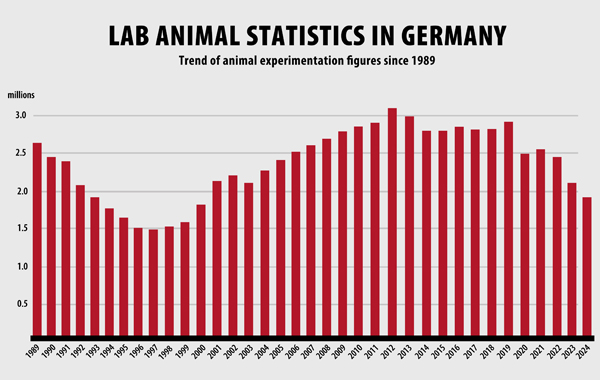
Figure 2: The graph shows the number of animals used in animal experiments and killed for scientific purposes.
Species used in animal experiments
As in previous years, mice are by far the most frequently used animal species in experiments with 956,636 individuals (72%). In second place are fish with 176.778 animals (13.3 %), followed by rats with 83.369 (6.3%). 57,966 rabbits were used. Almost 88% of these animals are used in routine production, which includes the production of polyclonal antibodies (2). In addition, birds (16,304), pigs (6,009), guinea pigs (5,157), dogs (2,220), monkeys (1,088), cats (698) and other animal species continue to be used.
The figures refer to ‘animals used in animal experiments’.
Experiments on non-human primates
The number of monkeys used in experiments fell by 35% from 1,676 in 2023 to 1,088 in 2024. It remains unclear whether this represents a sustainable decline. The figures are subject to considerable fluctuations, particularly in this area.
Of the 1,088 monkeys used in 2024, 222 were reused. The proportion of monkeys reused was already comparatively high in the previous year at 11% and rose to 20% in 2024. In basic research in particular, monkeys are reused in experiments such as invasive brain research – often over years or decades (3).
Of the monkeys used in experiments for the first time, 730 came from non-EU countries, namely from countries in Asia or Africa. By comparison, only 146 animals were obtained from registered breeders within the EU.
The majority of monkeys (870 animals, 80%) were used for regulatory purposes such as toxicity testing. Most of the monkeys in Germany are used by the company ‘Lapcorp’ (formerly Covance) (4).
Basic research is the largest consumer of animals
It is particularly striking that the number of animals used for basic research, which by definition has no purpose and must suffer or die in the process, has remained at a consistently high level for years. These animal experiments have accounted for more than half of all animal experiments for years.
In 1999, 438,000 animals were used in basic research, four years later there were already around twice as many animals (851,000 animals). In 2016, basic research reached its highest level to date with 1,175,664 animals.
In 2023, 852,209 animals were used in basic research, which corresponds to a share of 58.5% and represents an increase of 3% compared to the previous year. In 2024, the number fell slightly to 758,244 animals, but still corresponds to a share of 57%. The figures refer to animals used in animal experiments.
Regulatory animal testing on the decline
In the early 1990s, regulatory animal experiments accounted for a very large proportion of around 36%, with absolute figures of around half a million animals per year. These figures fell steadily to 224,000 animals (11%) in 2013. This was followed by an increase, which was, however, due to a new counting method. Animals killed for scientific purposes were no longer listed as a separate column, but were assigned to the purposes. In 2014, regulatory animal experiments accounted for 20% of the total, with over 660,000 animals.
Since then, there has been a downward trend in this area, which continued in 2024. The abolute number of animals and percentages have continued to fall, from 246,650 (16.9%) in 2023 to 221,157 (16.7%) in 2024.
The long-term downward trend in this area is due to the growing number of available animal-free methods. These are methods that do not involve live animals, e.g. organ-on-chip systems, cell cultures, and computer-based models. This also includes clinical and epidemiological research. Such modern research methods should be increasingly promoted. In contrast to animal testing, non-animal test systems offer reliable results that can be transferred to humans.
The figures given by the Bf3R in this area relate only to animals used directly in experiments.
The number of genetically modified animals continues to be high
In 2024, 658.559 animals were genetically modified, which corresponds to a share of 49,6 % (in 2023 it was 50.5 %). The most frequently genetically modified animals are mice, fish and rats. Little has changed here compared to the previous year, but in 2011 the proportion was only 25%.
Although the number of genetically modified animals in 2024 (658,559) is lower than in the previous year (738,066), the actual number is significantly higher, as these statistics only take into account animals used in animal experiments. Many of the so-called surplus animals, which are also genetically manipulated, are now included in a separate breakdown. A total of 931,874 genetically modified animals, mainly mice and fish, were killed as surplus, which accounts for 88% of all surplus animals.
The figures for ‘animals killed for scientific purposes’ with genetic modification are now also broken down in detail: organs or tissue were removed for scientific purposes from 358,281 animals that were genetically manipulated.
The total number of genetically modified animals recorded in the statistics is therefore 1,948,714.
47.708 animals endured 'severe' suffering
With a percentage share of 3.6%, the proportion of animal experiments in the ‘severe’ severity category remains almost the same compared to the previous year. In absolute terms, however, the number has fallen from 50,741 (2023) to 47,708 (2024) . Nevertheless, it must be taken into account that over 47,000 animals continued to experience severe suffering in 2024.
Experiments with mild distress account for 63.0% (previous year 63.8%), and experiments with moderate distress for 28.4% (previous year 27.5%). Experiments involving ‘non-recovery’ accounted for 5.0% in 2024 (previous year 5.3%). The latter means that the experiment is designed to kill the animals under anaesthesia, for example.
With the revision of the EU Animal Experiments Directive, the severity levels to which the animals are exposed have been recorded since 2014. It should be noted that the classification of severity levels is carried out by the researchers themselves - i.e. the people who have the greatest interest in these experiments being approved. A DAAE study showed that the severity levels are often understated.
Hidden animal suffering
There has been a fundamental change in the animal experimentation figures since 2021: animals that were bred in laboratories for scientific purposes but not used for these purposes and therefore killed as so-called surplus animals are also recorded (5).
Animals assigned to this area are, for example, animals that have been genetically modified but do not carry the desired genetic modification - and are therefore worthless for researchers. As there is no use for them in the laboratories, they are killed. It is also possible that animals don’t have the desired age or sex for the planned experiments and therefore become worthless for research.
Compared to previous years, there has been a sharp reduction in the number of surplus animals, which fell from 2.5 million (2021) to 1.4 million (2023) in just two years. This development raises the fundamental question of how seriously the problem of surplus animals was addressed in the past. In 2024, a further decline of almost 20% to 1.1 million animals was reported.
Hidden figures
The figures have another significant weakness in terms of transparency: All the animals that die in breeding facilities, during transport to the laboratory or before entering or after completion of an experimental project are not so-called surplus animals and are therefore not yet included in any statistics (5).
There is a further gap in the statistics for invertebrates. Apart from cephalopods (squid, octopuses), invertebrates such as insects and crustaceans are not counted at all. In 2024, 127 cephalopods were used, in 2023, the number was 70.
15/12/2025
Dr Johanna Walter
Further information
Bf3R: Animal experimentation statistics report 2024 (in German) >>
References
- German Center for the Protection of Laboratory Animals: Animal experimentation statistics report 2024
- Shocking discovery at a farm. DAAE, Press relese, 24.09.2025
- Gericke C. Affenhirnforschung – Großes Leid für Affen, kein Nutzen für Menschen. 16.12. 2024
- Gericke C. Lapcorp (Covance) - das größte Affenlabor Deutschlands. 15.08.2024
- Strittmatter S. 4 Millionen Tiere als „Überschuss“ in Tierversuchslaboren getötet. 02.08.2021