Where cats and dogs suffer in German laboratories
- News
New investigation by Doctors Against Animal Experiments reveals the extent of such experiments for the first time
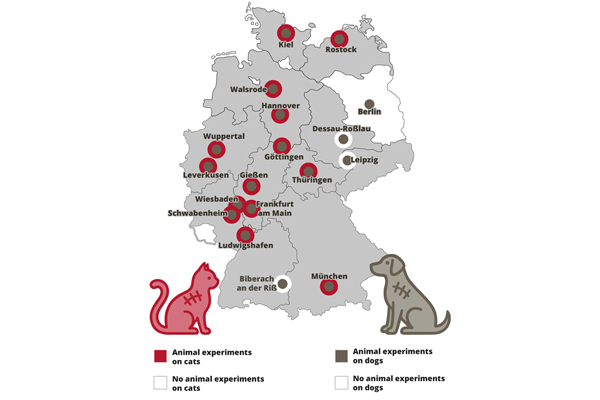
The German association Doctors Against Animal Experiments has, for the first time, carried out a comprehensive investigation into which facilities in Germany use dogs and cats in animal experiments. The investigation identified 19 facilities where experiments on dogs and cats have taken place in recent years. Every year, between 2,200 and 4,500 dogs and between around 500 and over 1,100 cats are used in laboratories. The organisation also criticises significant gaps in the official records and calls for an end to all animal experiments.
For the research, Doctors Against Animal Experiments (DAAE) analysed the official statistics on animal use for scientific purposes from the Federal Institute for Risk Assessment for the years 2015 to 2024 and cross-referenced these with parliamentary questions, scientific publications, job advertisements, entries from the organisation’s own database and insider information.
The report identified, for the first time, a total of 19 animal testing facilities where experiments on dogs and cats have taken place recently or are currently taking place. These include several pharmaceutical companies such as Boehringer Ingelheim, Bayer, AbbVie, MSD Animal Health and Ceva Innovation. It also includes contract laboratories such as Klifovet in Munich and BioMedVet in Walsrode, all veterinary universities which are located in Berlin, Giessen, Hanover, Leipzig and Munich, as well as other institutions such as the Ernst Strüngmann Institute in Frankfurt, Medical University Hanover and the universities of Göttingen and Kiel.
The federal states of Baden-Württemberg, Bavaria, Hesse, Lower Saxony and North Rhine-Westphalia recorded particularly high figures. North Rhine-Westphalia and Hesse were the dubious ‘top users’ of dogs in 2023 and 2024. In 2023, over 850 dogs were used in Hesse, and in 2024, over 570 dogs were used in North Rhine-Westphalia. North Rhine-Westphalia also was the state with the highest use of cats, with 200 and 240 animals in 2023 and 2024 respectively. For both species, the majority involved regulatory testing, i.e. trials to test drugs and chemicals.
For many years, Lower Saxony stood out for its exceptionally high numbers of dogs used in experiments, in some cases exceeding 1,000 animals. The LPT contract laboratory in Mienenbüttel, which has since been closed, played a central role in this. Following the publication of undercover footage and massive public outcry, the numbers fell significantly.
The investigation also documents a wide range of cruel experiments. Dogs were used, for example for research into heart failure, pain studies, toxicity tests and dental experiments. Experiments on cats were carried out in fields such as animal nutrition, brain research, infection studies and hearing research.
The analysis also reveals significant shortcomings in the transparency of animal experiments. Official statistics provide only figures broken down by federal state and by purpose of the experiments. Only through extensive research is it possible to trace where dogs and cats are suffering in German laboratories. At the same time, many questions remain unanswered. For instance, in 2024, Mecklenburg-Western Pomerania suddenly reported 99 dogs and 103 cats in applied research, even though hardly any or no animals of these species had been used there in previous years. It remains unclear which institution is responsible for this.
Dr Corina Gericke, DVM, Vice-Chair of Doctors Against Animal Experiments, said: “This latest analysis provides the first insight into a system of secrecy and deception surrounding experiments on dogs and cats. Recent undercover footage from a British contract laboratory once again documents the unimaginable suffering of dogs and other animals,” Gericke reports. “As these are standard experiments carried out for regulatory purposes, it can be assumed that the associated suffering is also standard practice and that the situation is no different in German laboratories.”
DAAE is calling for an end to all animal experiments and a systematic shift towards modern, animal-free research methods that are relevant to human health.